Today's
EarthStation1.com 15% (Or More!) Off Commemorative Memorial Title:
TV Commercials: The Classics Vol. 2 DVD, Video Download, USB Drive
Today, July 28, 2026
July 28: National Milk Chocolate Day: --
Today we dive into the ever-popular National Milk Chocolate Day, a
day of observance created by the National Confectioners
Association. When it comes to chocolate, this sweet easily
pleases. On average, we recognize three chocolate holidays a
month. Interestingly, July celebrates chocolate as often as
February. Solid chocolate, when combined with either powdered,
liquid or condensed milk, is known as milk chocolate. While candy
bar makers use milk chocolate to make their most popular candy
bars, the treat isn't the healthiest of the chocolates. Dark
chocolate takes home the honors for nutrition. With added sugar
and fat, milk chocolate packs on the calories. Add to that, milk
chocolate's popularity in baked goods, and the calorie count keeps
going up. Don't forget, we add it to specialty coffee drinks and
other beverages, too. In fact, we've been adding milk to chocolate
beverages since the mid-17th century. But, in 1875 Daniel Peter
invented milk chocolate by mixing a powdered milk developed by
Henri Nestle with the liquor. It's been milk chocolate bliss ever
since. Since the days are heating up, melt that chocolate down.
Drizzle it on some ice cream or mix it into some popcorn. Nobody
said this holiday would be difficult. To observe National Milk
Chocolate Day, enjoy your favorite milk chocolate; create a
special treat with one of these recipes: Milk Chocolate Popcorn,
Chocolate Candy Bar Cake, or Milk Chocolate Pecan Pie! On Sale
Until Midnight Tonight PT!
https://store.earthstation1.com/tv-commercials-the-classics-vol-2-dv2.html
Today's
EarthStation1.com 15% (Or More!) Off Commemorative Memorial Title:
JFK Films & TV Broadcasts Of John F. Kennedy DVD, Download,
USB Drive
Today, July 28, 2026
July 28: National Soccer Day: -- Honors
and celebrates soccer - one of the world's most competitive and
popular sports. Every year, more than 17 million (around 5%)
Americans watch soccer matches during the National Football League
(N.F.L.). The irresistible urge to kick a rock lying by our feet
is something we all have in common, and a soccer ball is just a
bigger but less heavy version of a round stone. So, following that
logic, every civilization has had its version of soccer from time
immemorial. People in ancient China played a type of soccer known
as 'cuju' using a ball made of leather and feathers. Cuju later
spread to Japan, where it was known as 'kemari.' Similarly, the
Aztecs played a ritualistic game called 'ollama,' in which the
ball was considered a symbol of the sun, and the captain of the
losing team was sometimes sacrificed to the gods. Later, the
Mesoamericans used rubber balls - which were absent in other
cultures - to play a similar game. In its modern form, soccer can
be traced back to London. It was played in two styles: rugby and
Eton. In the beginning, the game rules were liberal, and there
weren't many restraints, so many people participated in the sport.
However, the lack of rules often led to heated matches and fatal
injuries. Eventually, the game's violent nature and serious injury
toll led to a country-wide ban. Yet, the game was so popular that
restrictions were lifted instantly. A few centuries later, in
1863, the first football association was formed in London. The
association standardized and established the first version of
soccer rules. They also banned the use of hands in the game and
created standards for the size and weight of the ball used in the
game. The new set of rules and standards divided the game into two
classes: football and rugby. Rugby allows players to hold the ball
in their hands and run, but soccer does not. Over time, the game's
popularity spread from England into its colonies, such as what is
now known as the U.S. On Sale Until Midnight Tonight PT!
https://store.earthstation1.com/jfk-films-dvd-president-john-f-kennedy.html
Today's
EarthStation1.com 15% (Or More!) Off Commemorative Memorial Title:
America: The Second Century Documentary Series DVD, Download, USB
Today, July 28, 2026
July 28: World Nature Conservation Day:
-- This day stresses the need for preserving a healthy environment
and natural resources to maintain a stable and healthy society.
Saving plants and animals that face the threat of extinction is
one of the primary goals of World Nature Conservation Day. Also,
the celebrations emphasize keeping the various components of
nature such as flora, fauna, energy resources, soil, water, and
air intact. In addition, World Nature Conservation Day underlines
the need for preserving the environment for future generations. We
are therefore tasked with the need to leave a healthy planet for
those coming after us to enjoy. Human activities during the last
century have had a devastating impact on natural vegetation and
other resources. The quest for rapid industrialization and cutting
down of forest cover to make space for the ever-growing population
has caused climate change and other environmental implications. As
much as awareness about environmental conservation has increased
in the past few years, there is still a long way to go before
positive steps show their results. In recent times, the need for
conserving the environment has become more evident. The relentless
human overexploitation of resources has led to unusual weather
patterns, destruction of wildlife habitats, extinction of species,
and loss of biodiversity. Sadly, this is the norm the world over.
That's why organizations like the International Union for
Conservation of Nature (I.U.C.N.) are important. In the first
decade of its existence, the organization focused on examining how
human activities affected nature. It also promoted the use of
environmental impact assessments, which have been widely adopted
across industries. In the 1960s and 1970s, most of the I.U.C.N.'s
work was directed toward the protection of species and their
habitats. In 1964, the I.U.C.N. founded the I.U.C.N. Red List of
Threatened Species_, which is currently the world's most
comprehensive data source on the risk of global extinction of
species. In the 2000s, the I.U.C.N. introduced 'nature-based
solutions.' These are actions that conserve nature while also
addressing global challenges such as climate change, security of
food and water, and poverty alleviation. The I.U.C.N. is currently
the world's largest and most diverse environmental network. On
Sale Until Midnight Tonight PT!
https://store.earthstation1.com/america-the-second-century-us-2nd-100-years-history-621006.html
Today's
EarthStation1.com 15% (Or More!) Off Commemorative Memorial Title:
The Buffalo Soldiers African American Soldier History DVD, MP4,
USB
Today, July 28, 2026
July 28: Buffalo Soldiers Day: --
Commemorates the formation of the first regular Army regiments
comprising African American soldiers in 1866. Congress established
the first peacetime all-black regiments in the regular U.S. Army
after the end of the Civil War. The Buffalo Soldiers (one of many
African American regiments raised during the Civil War) were the
first instituted. Since they were frontier regiments, Buffalo
Soldiers of the 9th and 10th Cavalries protected unsettled lands
as pioneers moved westward. They also faced the hardships of the
Wild West. During and after the Civil War, Army desertion rates
remained high. However, among Buffalo Soldiers, low rates
prevailed. They were also noted for their dedication and
commitment during the Spanish-American War and other engagements
during the late 1800s. During World War I, each unit received
stateside assignments, with some exceptions. Yet, neither unit saw
action during World War II. In 1944, the Army activated both
regiments and transferred service members to other units, as
integration in the military began. In honor of the first Buffalo
Soldiers Day in 1992, the United States Congress passed a law
designating July 28th as Buffalo Soldiers Day, and General Colin
Powell dedicated a monument to the Buffalo Soldier. It's located
at Fort Leavenworth, Kansas, where the 10th Calvary Buffalo
Soldiers were based. Since then, commemorations honoring the
Buffalo Soldiers have been held throughout the United States. The
Buffalo Soldier Museum is located in Houston, Texas. On September
6, 2005, the oldest living Buffalo Soldier died. Mark Matthews
lived to be 111 years old. For his dedicated services, he was laid
to rest at Arlington National Cemetery. To observe the holiday,
post on social media using #BuffaloSoldiersDay to encourage others
to pay tribute to these heroes; visit Buffalo Soldier monuments
across the country; read about their history and sacrifices. On
Sale Until Midnight Tonight PT!
https://store.earthstation1.com/the-buffalo-soldiers-dvd-african-american-soldier-history-dvd-mp4-us4.html
Today's
EarthStation1.com 15% (Or More!) Off Commemorative Memorial Title:
The Guns Of August (1964) WWI Film DVD, Video Download, USB Drive
Today, July 28, 2026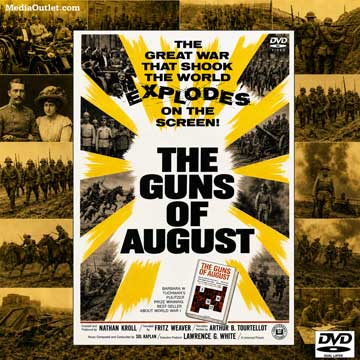
July 28, 1914: Causes Of The European
Civil War (Events Leading To The European Civil War): Causes Of
World War I (Events Leading To World War I): The Guns Of August:
The July Crisis: The Austro-Hungarian Declaration Of War On
Serbia: -- In the culmination of the July Crisis, Austria-Hungary
declares war on Serbia, igniting World War I. On July 23, 1914,
Austria-Hungary issued a series of demands in an ultimatum to the
Kingdom of Serbia demanding Serbia to allow the Austrians to
determine who assassinated Archduke Franz Ferdinand. Serbia
accepted all but one of those demands and Austria declared war on
July 28. The July Crisis was a series of interrelated diplomatic
and military escalations among the major powers of Europe in the
summer of 1914 that was the penultimate cause of World War I. The
crisis began on June 28, 1914, when Gavrilo Princip, a Serbian and
Yugoslavic partisan, assassinated Archduke Franz Ferdinand, heir
presumptive to the Austro-Hungarian throne. A complex web of
alliances, coupled by miscalculations by many leaders that war was
in their best interests or that a general war would not occur,
resulted in a general outbreak of hostilities among every major
European nation in early August 1914. Austria-Hungary believed
Serbia promoted South Slavs' irredentist movements (political and
popular movements to reclaim and occupy land the movement
considers "lost" from their nation's past) in order to
be a threat to the unity of the nation. Following the
assassination, Austria sought to inflict a military blow on Serbia
to demonstrate strength and so Serbia would be more cautious about
supporting Yugoslavic nationalism. However, it was wary of the
reaction of the Russian Empire, who were a major supporter of
Serbia, so sought a guarantee from its ally Germany that it would
support Austria in any conflict. Germany guaranteed its support,
but urged Austria to attack quickly, while world sympathy for the
murdered heir was high, in order to localize the war and avoid
drawing in Russia. Some German leaders believed that growing
Russian economic power would change the balance of power between
the two nations, that a war was inevitable, and that Germany would
be better off if a war happened soon. However, rather than a quick
attack with available military forces, Austrian leaders
deliberated into mid-July before deciding that it would give
Serbia a harsh ultimatum on 23 July and would not attack without a
full mobilization of its army that could not be accomplished
before 25 July 1914. Just prior to the Serbian reply to the
ultimatum, Russia decided that it would intervene in any
Austro-Serbian war and ordered a partial mobilization of its armed
forces. While Russian military leadership acknowledged that Russia
was not yet strong enough for a general war, Russia believed the
Austrian grievance against Serbia was a pretext orchestrated by
Germany and that it needed to show strength by protecting its
Serbian ally. This mobilization was the first major military
action not by a direct participant in the conflict between
Austria-Hungary and Serbia; it increased the willingness of Serbia
to defy the threat of an Austrian attack and greatly increased the
alarm in Germany about masses of Russian troops being assembled
near its borders. Previously, the German military predicted that
Russian mobilization would be slower than that of its French ally
on Germany's opposite border; therefore, German military strategy
in any conflict with Russia was to attack through Belgium to avoid
French fixed defenses and quickly defeat France in the west before
turning to face Russia in the east. France was aware that it would
have to act together with its Russian ally to defeat its German
rival, so escalated its preparations as tensions along the Russian
border increased, which in turn further alarmed Germany. While
Great Britain was aligned with Russia and France, it also had
relatively friendly diplomatic relations with Germany, and many
British leaders saw no compelling reason to involve Britain in a
Continental war. Britain repeatedly offered to mediate, using the
Serbian reply as the basis of negotiation, and Germany made
various promises in an attempt to ensure British neutrality.
However, Britain decided that it had a moral obligation to defend
Belgium and aid its formal allies, becoming the last major nation
to formally enter the conflict on 4 August. In early August, the
ostensible reason for armed conflict, the dispute between Serbia
and Austria-Hungary over the murdered heir, had already become a
sidenote to a general European war. On Sale Until Midnight Tonight
PT!
https://store.earthstation1.com/the-guns-of-august-dvd-1964-world-war-i-movie-documen1964.html
Today's
EarthStation1.com 15% (Or More!) Off Commemorative Memorial Title:
Air Power WWII TV Series With Walter Cronkite DVD, Video Download,
USB
Today, July 28, 2026
July 28, 1943: The European Civil War:
World War II: The Second European War (The European Theater Of
World War II): The Western Front Of World War II: Aviation:
Military Aviation: Air Warfare Of World War II: Strategic Bombing
During World War II: European Air Operations During The Battle Of
Europe: RAF Strategic Bombing During The Second World War: USAAF
Strategic Bombing During The Second World War: The Bombing Of
Hamburg In World War II: The Battle Of Hamburg: Operation
Gomorrah: -- The Royal Air Force bombs Hamburg, Germany causing a
firestorm that kills 42,000 German civilians. The allied bombing
of Hamburg during World War II included numerous attacks on
civilians and civic infrastructure. As a large city and industrial
centre, Hamburg's shipyards, U-boat pens, and the Hamburg-Harburg
area oil refineries were attacked throughout the war. As part of a
sustained campaign of strategic bombing during World War II, the
attack during the last week of July 1943, code named Operation
Gomorrah, created one of the largest firestorms raised by the
Royal Air Force and United States Army Air Forces in World War II,
killing 42,600 civilians and wounding 37,000 in Hamburg and
virtually destroying most of the city. Before the development of
the firestorm in Hamburg there had been no rain for some time and
everything was very dry. The unusually warm weather and good
conditions meant that the bombing was highly concentrated around
the intended targets and also created a vortex and whirling
updraft of super-heated air which created a 460 meter high tornado
of fire. The firestorm occurred after 2,326 tons of bombs and
incendiaries were dropped by the Allies. Various other previously
used techniques and devices were instrumental as well, such as
area bombing, Pathfinders, and H2S radar, which came together to
work with particular effectiveness. An early form of chaff, code
named 'Window', was successfully used for the first time by the
RAF - clouds of tinfoil strips dropped by Pathfinders as well as
the initial bomber stream - in order to completely cloud German
radar. The raids inflicted severe damage to German armaments On
Sale Until Midnight Tonight PT!
https://store.earthstation1.com/air-power-original-1950s-tv-series-walter-cronkite-4-dv19504.html
Today's
EarthStation1.com 15% (Or More!) Off Commemorative Memorial Title:
The Gallant Breed: US Marine Chronicles + 2 Bonuses MP4 Download
DVD
Today, July 28, 2026
July 28, 1915: The United States: The
History Of The United States: United States Expansionism: American
Imperialism: The Banana Wars : The United States Occupation Of
Haiti: The American Invasion Of Haiti: -- The United States begins
a 20-year occupation of Haiti begins when United States President
Woodrow Wilson orders 340 United States Marines to occupy
Port-Au-Prince. The invasion took place that same day, with 330
U.S. Marines landing at Port-Au-Prince, Haiti, after the National
City Bank of New York convinced the President of the United
States, Woodrow Wilson, to take control of Haiti's political and
financial interests. The Secretary of the Navy instructed the
invasion commander, Rear Admiral William Banks Caperton, to
"protect American and foreign" interests. Wilson also
wanted to rewrite the Haitian constitution, which banned foreign
ownership of land, to replace it with one that guaranteed American
financial control. To avoid public criticism, Wilson claimed the
occupation was a mission to "re-establish peace and order ...
[and] has nothing to do with any diplomatic negotiations of the
past or the future," as disclosed by Rear Admiral Caperton.
Only one Haitian soldier, Pierre Sully, tried to resist the
invasion, and he was shot dead by the Marines. The United States
Occupation Of Haiti (July 28, 1915 - August 1, 1934) took place
following years of socioeconomic instability within Haiti that
culminated with the lynching of President of Haiti Vilbrun
Guillaume Sam by a mob angered by his decision to order the
executions of political prisoners. The invasion and subsequent
occupation was promoted by growing American business interests in
Haiti, especially the National City Bank of New York, which had
withheld funds from Haiti and paid rebels to destabilize the
nation through the Bank of the Republic of Haiti with an aim at
inducing American intervention. During the occupation, Haiti had
three new presidents while the United States ruled as a military
regime through martial law led by Marines and the Gendarmerie. Two
major rebellions against the occupation occurred, resulting in
several thousand Haitians killed, and numerous human rights
violations - including torture and summary executions - by Marines
and the Gendarmerie of Haiti. A corvee system of forced labor was
used by the United States for infrastructure projects, that
resulted in hundreds to thousands of deaths. Under the occupation,
most Haitians continued to live in poverty, while American
personnel were well-compensated. The American occupation ended the
constitutional ban on foreign ownership of land, which had existed
since the foundation of Haiti. The occupation ended on August 1,
1934, after President Franklin D. Roosevelt reaffirmed an August
1933 disengagement agreement. The last contingent of marines
departed on August 15, 1934, after a formal transfer of authority
to the American-created Gendarmerie of Haiti. On Sale Until
Midnight Tonight PT!
https://store.earthstation1.com/the-gallant-breed-dvd-set-3-part-us-marine-history-2-dis32.html
Today's
EarthStation1.com 15% (Or More!) Off Commemorative Memorial Title:
After The Crash: The 1932 Bonus Army March MP4 Download DVD USB
Drive
Today, July 28, 2026
July 28-29, 1932: The European Civil War:
World War I: The First European War (The European Theater Of World
War I): The Aftermath Of World War I: The Aftermath Of World War I
In The United States: The Interwar Period (The Interbellum,
Between The Wars): The Great Depression: The Great Depression In
The United States: The Bonus Army (The Bonus March): The Bonus
Army Eviction: -- President Herbert Hoover orders the United
States Army to forcibly evict the "Bonus Army" of World
War I veterans gathered in Washington, D.C.. U.S. Army troops
under the command of Gen. Douglas MacArthur, Major Dwight D.
Eisenhower and Major George S. Patton, attacked and burned the
encampments of unemployed World War I veterans. Eight days prior,
on July 20, 1932 in Washington, D.C., police fired tear gas at the
World War I veterans, part of the Bonus Expeditionary Force, who
attempted to march to the White House. Known as the Bonus Army,
they were an assemblage of some 43,000 marchers: 17,000 U.S. World
War I veterans, their families, and affiliated groups: who
gathered in Washington, D.C. in the summer of 1932 to demand
cash-payment redemption of their service certificates. Organizers
called the demonstrators the "Bonus Expeditionary Force",
to echo the name of World War I's American Expeditionary Forces,
while the media referred to them as the "Bonus Army" or
"Bonus Marchers". On June 17, 1932, around a thousand
World War I veterans amassed at the United States Capitol as the
U.S. Senate deliberated and voted on the Wright Patman Bonus Bill,
which had passed the US House of Representatives on June 15th,
that would move forward the payment date for World War I veterans
to receive the cash bonuses they were to receive in 1945 according
to the World War Adjusted Compensation Act of 1924, also known as
the Bonus Act. The bill was defeated in the US Senate by a vote of
62-18. The Bonus Army were the 43,000 marchers - 17,000 U.S. World
War I veterans, their families, and affiliated groups - who
gathered in Washington, D.C. in the summer of 1932 to demand
cash-payment redemption of their service certificates. Organizers
called the demonstrators the "Bonus Expeditionary Force",
to echo the name of World War I's American Expeditionary Forces,
while the media referred to them as the "Bonus Army" or
"Bonus Marchers". The contingent was led by Walter W.
Waters, a former sergeant. Many of the war veterans had been out
of work since the beginning of the Great Depression. The World War
Adjusted Compensation Act of 1924 had awarded them bonuses in the
form of certificates they could not redeem until 1945. Each
certificate, issued to a qualified veteran soldier, bore a face
value equal to the soldier's promised payment compound interest.
The principal demand of the Bonus Army was the immediate cash
payment of their certificates. On July 28, U.S. Attorney General
William D. Mitchell ordered the veterans removed from all
government property. Washington police met with resistance, shots
were fired and two veterans were wounded and later died. President
Herbert Hoover then ordered the Army to assemble on Pennsylvania
Avenue to clear the marchers from the area. Army Chief Of Staff
General Douglas MacArthur, along with his aide Major Dwight D.
Eisenhower, commanded the infantry and cavalry, supported by six
tanks under the command of Major George S. Patton . Despite two
orders by President Hoover to General MacArthur not to cross the
Anacostia bridge into the Bonus Army marcher's camp that night,
the marchers with their wives and children were forcibly driven
out of their campsite, and their shelters and belongings burned. A
second, smaller Bonus March in 1933 at the start of the Roosevelt
administration was defused in May with an offer of jobs with the
Civilian Conservation Corps at Fort Hunt, Virginia, which most of
the group accepted. Those who chose not to work for the CCC by the
May 22 deadline were given transportation home. In 1936, Congress
overrode President Roosevelt's veto and paid the veterans their
bonus nine years early. On Sale Until Midnight Tonight PT!
https://store.earthstation1.com/after-the-crash-the-1932-bonus-march-of-the-great-depression1932.html
Today's
EarthStation1.com 15% (Or More!) Off Commemorative Memorial Title:
The American Adventure: TV History Series 1607-1876 DVD MP4 USB
Drive
Today, July 28, 2026
July 28, 1868: The Reconstruction Era
(Reconstruction): The Constitution Of The United States: The
Reconstruction Amendments: Black Suffrage (Black Political
Franchise, Black Franchise, Black Right To Vote, Black Active
Suffrage): The Fourteenth Amendment To The United States
Constitution (Amendment XIV): -- The 14th Amendment To The United
States Constitution is certified, guaranteeing African Americans
full citizenship and all persons in the United States due process
of law. It had been ratified on July 9, 1868. The Fourteenth
Amendment (Amendment XIV) to the United States Constitution was
adopted as one of the Reconstruction Amendments. The amendment
addresses citizenship rights and equal protection of the laws and
was proposed in response to issues related to former slaves
following the American Civil War. The amendment was bitterly
contested, particularly by the states of the defeated Confederacy,
which were forced to ratify it in order to regain representation
in Congress. The amendment, particularly its first section, is one
of the most litigated parts of the Constitution, forming the basis
for landmark decisions such as Brown v. Board of Education (1954)
regarding racial segregation, Roe v. Wade (1973) regarding
abortion, Bush v. Gore (2000) regarding the 2000 presidential
election, and Obergefell v. Hodges (2015) regarding same-sex
marriage. The amendment limits the actions of all state and local
officials, including those acting on behalf of such an official.
The amendment's first section includes several clauses: the
Citizenship Clause, Privileges or Immunities Clause, Due Process
Clause, and Equal Protection Clause. The Citizenship Clause
provides a broad definition of citizenship, nullifying the Supreme
Court's decision in Dred Scott v. Sandford (1857), which had held
that Americans descended from African slaves could not be citizens
of the United States. The Privileges or Immunities Clause has been
interpreted in such a way that it does very little. The Due
Process Clause prohibits state and local government officials from
depriving persons of life, liberty, or property without
legislative authorization. This clause has also been used by the
federal judiciary to make most of the Bill Of Rights applicable to
the states, as well as to recognize substantive and procedural
requirements that state laws must satisfy. The Equal Protection
Clause requires each state to provide equal protection under the
law to all people, including all non-citizens, within its
jurisdiction. This clause has been the basis for many decisions
rejecting irrational or unnecessary discrimination against people
belonging to various groups. The second, third, and fourth
sections of the amendment are seldom litigated. However, the
second section's reference to "rebellion and other crime"
has been invoked as a constitutional ground for felony
disenfranchisement. The fourth section was held, in Perry v.
United States (1935), to prohibit a current Congress from
abrogating a contract of debt incurred by a prior Congress. The
fifth section gives Congress the power to enforce the amendment's
provisions by "appropriate legislation"; however, under
City of Boerne v. Flores (1997), this power may not be used to
contradict a Supreme Court decision interpreting the amendment. On
Sale Until Midnight Tonight PT!
https://store.earthstation1.com/the-american-adventure-series-us-1st-century-4-dv14.html
Today's
EarthStation1.com 15% (Or More!) Off Commemorative Memorial Title:
Black Civil Rights Films: African-American History DVD, MP4, USB
Stick
Today, July 28, 2026
(#JCKaelin here: One takeaway: President
Wilson's legacy is filled with disgraceful racism like this, much
more than his enthusiam for D. W. Griffith's film "Birth Of A
Nation" betrayed.) ========= July 28, 1917: White Supremacy:
Terrorism: Anti-Black Racism: Anti-Black Racism In The United
States: The Nadir Of American Race Relations (1877/1890 -
1901/1923/1941 [Dates Disputed]): Race Riots: Race Riots In The
United States: Union Violence In The United States: Labour Revolts
(Labor Revolts, Labor Revoltutions, Labour Revoltutions, Worker's
Uprisings): The East St. Louis Massacre (The East St. Louis Riots,
The East St. Louis Pogrom): The Anti-Lynching Movement: The Negro
Silent Protest Parade (The Silent Parade): -- The first large
black-only protest parade in New York occurs when some 10,000
black citizens, organized by the NAACP, are led down New York
City's Fifth Avenue, beginning at 57th Street and ending at 23rd
Street, by W.E.B. DuBois and James Weldon Johnson, march in silent
protest against murders, lynchings, and other violence directed
towards African Americans, precipitated by the East St. Louis
riots in May and July 1917, where at least 40 black people were
killed by white mobs in part touched off by a labor dispute where
blacks were used for strike breaking, by The Lynching Of Jesse
Washington in Waco, Texas (May 15, 1916), and by the recent
Lynching Of Ell Persons in Memphis, Tennessee (May 22, 1917).
Protesters carried signs that highlighted their discontent. Some
signs and banners appealed directly to President Woodrow Wilson. A
mounted police escort led the parade. Women and children were
next, dressed in white. They were followed by the men, dressed in
black. People of all races looked on from both sides of Fifth
Avenue. The New York Age estimated that "fully fifteen
thousand Negroes, who should have taken an active part, looked
on." Black boy scouts handed out fliers describing why they
were marching. During the parade, white people stopped to listen
to black people explain the reasons for the march and other white
bystanders expressed support and sympathy. Some of the messages
written on fliers were: "We march because by the Grace of God
and the force of truth, the dangerous, hampering walls of
prejudice and inhuman injustices must fall."; "We march
because we deem it a crime to be silent in the face of such
barbaric acts."; "We march because we want our children
to live a better life and enjoy fairer conditions than have fallen
to our lot." The New York Times described it the following
day: "To the beat of muffled drums 8,000 negro men, women and
children marched down Fifth Avenue yesterday in a parade of
"silent protest against acts of discrimination and
oppression" inflicted upon them in this country, and in other
parts of the world. Without a shout or a cheer they made their
cause known through many banners which they carried, calling
attention to "Jim Crowism," segregation,
disenfranchisement, and the riots of Waco, Memphis, and East St.
Louis." Media coverage of the march helped to counter the
dehumanization of black people in the United States. The parade
and its coverage helped depict the NAACP as a "well-organized
and mannerly group" and also helped increase its visibility
both among white and black people alike. Marchers hoped to
influence Democratic President Wilson to carry through on his
election promises to African American voters to implement
anti-lynching legislation and promote Black causes. Four days
after the silent parade, black leaders involved in the protest,
including Madame C.J. Walker, went to Washington D.C. for a
planned appointment with the president. Wilson disgracefully did
not keep the appointment, as the group of leaders were told that
Wilson had "another appointment." They left their
petition for Wilson, which reminded him of African Americans
serving in World War I and urged him to prevent riots and
lynchings in the future. Wilson again disgracefully did not do so
and repudiated his promises. Federal discrimination against
African Americans significantly increased under the Wilson
administration. On Sale Until Midnight Tonight PT!
https://store.earthstation1.com/black-civil-rights-films-africanamerican-history-dvd.html
Today's
EarthStation1.com 15% (Or More!) Off Commemorative Memorial Title:
Fall Of The Great Society & The Silent Majority: LBJ &
Nixon MP4 DVD
Today, July 28, 2026
July 28, 1965: The Aftermath Of World War
II: The Cold War: The Cold War In Asia: The Indochina Wars: The
Vietnam War (The Second Indochina War, The Vietnam Conflict, The
Resistance War Against America): The United States In The Vietnam
War: The Escalation Of The Vietnam War: --U.S. President Lyndon B.
Johnson announces at a news conference, carried on nationwide
radio and television, the "most agonizing and painful duty"
of his office: his order to increase by 50,000 the number of
United States troops in South Vietnam, from 75,000 to 125,000
troops. He said that to provide this additional manpower that he
would raise the monthly draft call from 17,000 to 35,000, and by
stepping up the campaign for voluntary enlistments. Johnson said
the U.S. 1st Cavalry Division, a crack air assault and infantry
outfit stationed at Ft. Benning, Ga., and "certain forces"
were being ordered to Viet Nam as soon as possible. But the
President said he had decided that it was not necessary to order
up the reserves "at this time." There had been
speculation he might call up as many as 150,000 reservists, and he
did not preclude such action later. The President made no effort
to minimize the seriousness of the situation in Viet Nam, saying
flatly at one point: "This is war." Johnson's decision
capped a week-long series of top-level conferences with his aides
and congressional leaders. Johnson said bluntly that additional
forces would be needed in South Viet Nam, "and they will be
sent." At the same time, the President renewed his call for
moving the issue of Viet Nam from Ihe battlefield to the
conference table." He appealed to "the United Nalions,
its officials, or anyone of its 114 members" to help bring an
honorable peace. He said in this connection that he had directed
Arthur J. Goldberg, new U.S. ambassador to Ihe United Nations, to
present immediately to Secretary General U Thant a letter
"requesting that all the resources, energy and immense
prestige of the United Nations be employed to find ways lo halt
aggression and bring peace in Viet Nam." The President said
that if such efforts did not bring a settlement, "we will
persist, if persist we must, until death and desolation have led
to the same conference table where others could now join is at so
much smaller cost." To pay for the military step-up, Johnson
said he would ask Congress for a limited addition to the defense
appropriation bill then pending before the Senate Appropriations
Committee. "These steps, like our actions in the past, are
carefully measured to do what must be done to bring about an end
to aggression and a peaceful settlement," the President said.
"We do not want an expanding struggle, with consequences no
one can foresee. Nor will we bluster or bully or flaunt our power.
But we will not surrender and we will not retreat." On Sale
Until Midnight Tonight PT!
https://store.earthstation1.com/fall-of-the-great-society-amp-the-silent-majority-lbj-amp-nixon-mp4-dv4.html
Today's
EarthStation1.com 15% (Or More!) Off Commemorative Memorial Title:
LBJ 1991 TV Documentary Series Lyndon Johnson DVD Download USB
Drive
Today, July 28, 2026
July 28, 1967: Civil Rights Movements:
The American Civil Rights Movement (1954-1968): The Ghetto Riots
(The Ghetto Rebellions, The Race Riots, The Negro Riots)
(1964-1969): The Long, Hot Summer of 1967: The Detroit Riots: The
1967 Detroit Riot (The 12th Street Riot, The Detroit Uprising): --
The bloodiest race riot in the "Long, Hot Summer Of 1967",
one of the worst riots in United States history, ends on a Friday
following the last major fire in the riot, and troops began to
withdraw. By the day prior, Thursday July 27, sufficient order had
returned to the city that officers withdrew ammunition from the
National Guardsmen stationed in the riot area and ordered them to
sheath their bayonets. The Army troops were completely withdrawn
by Saturday, July 29. The 1967 Detroit Riot began in the early
hours of Sunday July 23 on 12th Street in Detroit, Michigan in the
predominantly African American inner city. Also known as the 12th
Street Riot and the Detroit Rebellion, it consisted mainly of
confrontations between black people and police. The precipitating
event was a police raid of an unlicensed, after-hours bar then
known as a blind pig, on the city's Near West Side. It exploded
into one of the deadliest and most destructive riots in American
history, lasting five days and surpassing the violence and
property destruction of Detroit's 1943 race riot 24 years earlier.
To help end the disturbance, Governor George W. Romney ordered the
Michigan Army National Guard into Detroit, and President Lyndon B.
Johnson sent in the United States Army's 82nd and 101st Airborne
Divisions. The result was 43 dead, 1,189 injured, over 7,200
arrests, and more than 2,000 buildings destroyed. The scale of the
riot was the worst in the United States since the 1863 New York
City draft riots during the American Civil War, and was not
surpassed until the 1992 Los Angeles riots 25 years later. The
riot was prominently featured in the news media, with live
television coverage, extensive newspaper reporting, and extensive
stories in Time and Life magazines. The staff of the Detroit Free
Press won the 1968 Pulitzer Prize for general local reporting for
its coverage. Isaac Hayes, co-author of the Sam & Dave hit
single "Soul Man", found the inspiration for the song in
the turmoil of The 1967 Detroit Riot while watching a television
newscast of the aftermath of the riot; Hayes noted that black
residents had marked buildings that had not been destroyed during
the riots - mostly African-American owned and operated
institutions - with the word "soul". Relating this
occurrence to the biblical story of the Passover, Hayes and his
co-author of the song partner David Porter came up with the idea,
in Hayes's words, of "a story about one's struggle to rise
above his present conditions. It's almost a tune kind of like
boasting, 'I'm a soul man.' It's a pride thing." On Sale
Until Midnight Tonight PT!
https://store.earthstation1.com/lbj-1991-tv-documentary-series-lyndon-johnson-dvd-download-usb-d1991.html
Today's
EarthStation1.com 15% (Or More!) Off Commemorative Memorial Title:
Eyes On The Prize II: America At The Racial Crossroads DVD MP4 USB
Today, July 28, 2026
July 28, 1967: Civil Rights Movements:
The American Civil Rights Movement (1954-1968): The Ghetto Riots
(The Ghetto Rebellions, The Race Riots, The Negro Riots)
(1964-1969): The Long, Hot Summer of 1967: The Detroit Riots: The
1967 Detroit Riot (The 12th Street Riot, The Detroit Uprising): --
In response to the devastating rioting still underway in Detroit,
Michigan, as well as the wave of race riots spread across the
United States during The Long, Hot Summer Of 1967, President
Lyndon Johnson appoints The Kerner Commission to investigate these
riots, and to provide recommendations for the future. The
Commission's final report, The Report Of The National Advisory
Commission On Civil Disorders, better known as The Kerner Report,
was released on February 29, 1968 (Leap Day, a suspicious choice
for a date since that date can only be commemorated once every
four years), concluded that the riots resulted from black
frustration at the lack of economic opportunity; it berated
federal and state governments for failed housing, education and
social-service policies; it aimed some of its sharpest criticism
at the mainstream media with the words "The press has too
long basked in a white world looking out of it, if at all, with
white men's eyes and white perspective"; and most damning of
all, the report's most famous passage: "Our nation is moving
toward two societies, one black, one white -- separate and
unequal."
https://store.earthstation1.com/eyes-on-the-prize-ii-dvd-set-4-discs-complete-2nd-seri42.html
On Sale Until Midnight Tonight PT!
https://store.earthstation1.com/eyes-on-the-prize-ii-dvd-set-4-discs-complete-2nd-seri42.html
Today's
EarthStation1.com 15% (Or More!) Off Commemorative Memorial Title:
1960 Democratic & Republican National Conventions DVD MP4 USB
Drive
Today, July 28, 2026
July 28, 1960: Elections: Elections In
The United States: The 1960 United States Presidential Election:
The 1960 United States Republican National Convention: -- The 1960
Republican National Convention concludes in Chicago, Illinois,
running from July 25 to July 28, 1960 at the International
Amphitheatre. It was the 14th and most recent time overall that
Chicago hosted the Republican National Convention, more times than
any other city. The convention nominated Vice President Richard M.
Nixon for president and former Senator Henry Cabot Lodge Jr. of
Massachusetts for vice president. On Sale Until Midnight Tonight
PT!
https://store.earthstation1.com/1960-democratic-and-republican-national-conventions1960.html
Today's
EarthStation1.com 15% (Or More!) Off Commemorative Memorial Title:
The French Revolution Series + Irish Rebellion & You Are There
MP4 DVD
Today, July 28, 2026
July 28, 1794 (10 Thermidor, Year II):
The Age Of Enlightenment (The Enlightenment, The Age Of Reason):
The Age Of Revolution: The Atlantic Revolutions: The French
Revolution: The Thermidorian Reaction (9 Thermidor): -- #DOTD:
French Revolution leaders Maximilien Robespierre and Louis Antoine
de Saint-Just are executed by guillotine in Paris, France.
========= #DOTD: Maximilien Robespierre, French lawyer and
politician, was born May 6, 1758. Maximilien Francois Marie
Isidore de Robespierre was one of the best known and most
influential figures associated with the French Revolution and The
Reign Of Terror. As a member of the Estates-General, the
Constituent Assembly and the Jacobin Club, Robespierre was an
outspoken advocate for the poor and for democratic institutions.
He campaigned for universal male suffrage in France, price
controls on basic food commodities and the abolition of slavery in
the French colonies. He was an ardent opponent of the death
penalty, but played an important role in arranging the execution
of King Louis XVI, which led to the establishment of a French
Republic. He is perhaps best known for his role in the French
Revolution's Reign of Terror. He was named as a member of the
powerful Committee of Public Safety launched by his political ally
Georges Danton and exerted his influence to suppress the Hebertist
(a radical revolutionary political group associated with the
populist journalist Jacques Hebert). They came to power during The
Reign Of Terror and played a significant role in the French
Revolution.. As part of his attempts to use extreme measures to
control political activity in France, Robespierre later moved
against the more moderate Danton, who was accused of corruption
and executed in April 1794. The Terror ended a few months later
with Robespierre's arrest and execution in July, events that
initiated a period in French history known as the Thermidorian
Reaction (On 9 Thermidor Year II [27 July 1794], Robespierre was
denounced by members of the National Convention as "a
tyrant", leading to Robespierre and twenty-one associates
including Louis Antoine de Saint-Just being arrested that night
and beheaded on the following day). Robespierre's personal
responsibility for the excesses of the Terror remains the subject
of intense debate among historians of the French Revolution.
Influenced by 18th-century Enlightenment philosophes such as
Rousseau and Montesquieu, Robespierre was a capable articulator of
the beliefs of the left-wing bourgeoisie. His steadfast adherence
and defence of the views he expressed earned him the nickname The
Incorruptible. Robespierre's reputation has gone through several
cycles of re-appraisal. During the Soviet era, Robespierre was
used as an example of a revolutionary figure. His reputation
peaked in the 1920s with the influence of French historian Albert
Mathiez. In more recent times, his reputation has suffered as
historians have associated him with an attempt at a radical
purification of politics through the killing of enemies. He is
buried in a mass grave with other executed dissidents in the then
newly created Errancis cemetery in the 8th arrondissement of
Paris, one of the cemeteries (the others being Madeleine Cemetery,
Picpus Cemetery, Chapelle expiatoire and the Cemetery of Saint
Margaret) used to dispose of the corpses of guillotine victims
during the French Revolution. ========= #DOTD: Louis Antoine Leon
de Saint-Just (b. August 25, 1767) was a military and political
leader during the French Revolution. The youngest of the deputies
elected to the National Convention in 1792, Saint-Just rose
quickly in their ranks and became a major leader of the government
of the French First Republic. He spearheaded the movement to
execute King Louis XVI and later drafted the radical French
Constitution of 1793. He became a close friend of Maximilien
Robespierre, and served with him as one of the commissioners of
the Committee of Public Safety. Dispatched as a commissar to the
army during its rocky start in the French Revolutionary Wars,
Saint-Just imposed severe discipline, and he was credited by many
for the army's subsequent revival at the front. Back in Paris, he
supervised the consolidation of Robespierre's power through a
ruthless and bloody program of intimidation. In his relatively
brief time on the historical stage, he became the enduring public
face of The Reign Of Terror and was dubbed the "Angel of
Death" by later writers. Saint-Just organized the arrests and
prosecutions of many of the most famous figures of the Revolution.
Saint-Just was arrested in the violent episode of 9 Thermidor and
executed the next day with Robespierre and their allies. In many
histories of the Revolution, their deaths at the guillotine mark
the end of The Reign Of Terror. He is buried in a mass grave with
other executed dissidents in the then newly created Errancis
cemetery in the 8th arrondissement of Paris, one of the cemeteries
(the others being Madeleine Cemetery, Picpus Cemetery, Chapelle
expiatoire and the Cemetery of Saint Margaret) used to dispose of
the corpses of guillotine victims during the French Revolution. On
Sale Until Midnight Tonight PT!
https://store.earthstation1.com/the-french-revolution-dvd-3-part-tv-documentary-serie3.html
Today's
EarthStation1.com 15% (Or More!) Off Commemorative Memorial Title:
The Western Tradition TV Series DVD, MP4 Video Download, USB Drive
Today, July 28, 2026
July 28, 1655: #DOTD: #RIP: Cyrano De
Bergerac, French novelist, playwright, epistolarian (the author of
a written message conveyed from one person or group of people to
another through a medium), and duelist (b. March 6, 1619) #dies;
Edmond Rostand's play "Cyrano De Bergerac" suggests that
de Bergerac died of injures caused by a falling wooden beam in
1654 while entering the house of his patron, the Duc D'Arpajon.
However the academic and editor of Cyrano's works Madeleine
Alcover uncovered a contemporary text which suggests an attack on
the carriage of Guy Armand de Gramont, Count (then Duke) of
Guiche, a bisexual French nobleman, adventurer and one of the
greatest playboys of the 17th century. In that attack, a member of
his household was injured, and it is supposed that person is de
Bergerac. It is as yet inconclusive whether or not Cyrano's death
was a result of the injury, or an unspecified disease. de Bergerac
died over a year later on July 28, 1655, aged 36, at the house of
his cousin, Pierre De Cyrano, in Sannois, Paris, France. There is
strong evidence to support the theory that his death was actually
a result of a botched assassination attempt as well as further
damage to his health caused by a period of confinement in a
private asylum, orchestrated by his enemies, who succeeded in
enlisting the help of his own brother Abel de Cyrano. He was
buried in a convent church on the Rue de Charonne, in Sannois,
Paris, one of the oldest quarters of the city, according to an
October 24, 1908 report by The New York Times that cited M.
Lampau, Secretary of the commission of Old Paris, as its source.
That New York Times report went on to state that the convent,
along with other buildings in the area, had just been torn down,
and that "all traces of the place where he was buried have
disappeared and some of those who have been interested in the
subject are doubtful whether he was really buried there."
Cyrano De Bergerac was born Savinien de Cyrano De Bergerac in
Paris, France. Savinien II de Cyrano was the son of Abel I de
Cyrano, lord of Mauvieres, (156X-1648), counsel (avocat) of the
Parliament of Paris, and Esperance Bellanger (1586-164X), daughter
of the deceased nobleman Estienne Bellanger, Counsellor of the
King and Treasurer of his Finances. A bold and innovative author,
his work was part of the libertine literature of the first half of
the 17th century. Today, he is best known as the inspiration for
Edmond Rostand's most noted drama, Cyrano De Bergerac (1897),
which, although it includes elements of his life, also contains
invention and myth. Since the 1970s, there has been a resurgence
in the study of Cyrano, demonstrated in the abundance of theses,
essays, articles and biographies published in France and
elsewhere. Cyrano's short life is poorly documented. Certain
significant chapters of his life are known only from the Preface
of "The Other World: Comical History of the States and
Empires of the Moon (French: L'Autre monde ou les etats et empires
de la Lune), the first of three satirical novels written by Cyrano
De Bergerac, published in 1657, nearly two years after his death,
which along with its companion work "The States and Empires
of the Sun" is considered one of the earliest published
science fiction stories; Arthur C. Clarke credited the book with
the first description of rocket-powered spaceflight, and with the
invention of the ramjet. Were it not for Henri Le Bret, de
Bergerac's childhood friend, who had "The States And Empires
Of The Moon" published, and who wrote the biographical
information about de Begerac in it, his country childhood, his
military engagement, the injuries it caused, his prowess as a
swordsman, the circumstances of his death and his supposed final
conversion would have remained unknown. Since 1862, when French
author and historian Auguste Jal revealed that the "Lord of
Bergerac" was Parisian and not Gascon, research in parish
registries and notarial records by a small number of researchers,
in particular Madeleine Alcover of Rice University, has enabled
the public to know more about his genealogy, his family, his home
in Paris and those of some of his friends, research that has also
revealed no new documents that support or refute the essentials of
Le Bret's account or fill the gaps in his narrative. On Sale Until
Midnight Tonight PT!
https://store.earthstation1.com/the-western-tradition-dvd-set-all-52-shows-13-d5213.html
Today's
EarthStation1.com 15% (Or More!) Off Commemorative Memorial Title:
The Second Russian Revolution TV Series DVD, Video Download, USB
Drive
Today, July 28, 2026
July 28, 1974: The Aftermath Of World War
II: The Cold War: The Cold War (1962-1979): The Era Of Stagnation
(1964-1982): Special Forces: The History Of Special Forces:
Special Forces Of The Soviet Union: The History Of Special Forces
Of The Soviet Union: Spetsgruppa A (Russian: "Alpha Group:):
-- Spetsgruppa A, also known as Alpha Group, Russia's elite
special force, is formed. During the events of the Soviet coup
attempt in August 1991, Alpha Group's commanding officer, Gen.
Karpukhin, was commanded by KGB chairman, Vladimir Kryuchkov, to
forcibly enter the White House, Russia's acting parliament, after
paratroopers secured the entrance, to eliminate the President of
the Russian SFSR, Boris Yeltsin, and various other anti-coup
leaders assembled there. Gen. Karpukhin and Boris Beskov of Vympel
(Spetsgruppa V) convinced the KGB Deputy chairman, Gennady Ageyev,
that such a massive undertaking should be cancelled. Spetsgruppa
A, also known as Alpha Group (a popular English name), or Alfa,
whose official name is Directorate "A" of the FSB
Special Purpose Center (TsSN FSB), is an elite, stand-alone
sub-unit of Russia's special forces (Spetsnaz). It is a dedicated
counter-terrorism task force of the Russian Federal Security
Service (FSB), which primarily prevents and responds to violent
acts in public transportation and buildings. It was created by the
Soviet KGB in 1974. Although little is known about the exact
nature of its primary directives, it is speculated that the unit
is authorized to act under the direct control and sanction of
Russia's top political leadership, similar to its sister unit, the
Directorate "V" (Vympel), which is officially tasked
with protecting Russia's strategic installations. It is also
available for extended police duties, for paramilitary operations,
and for covert operations, both domestically and internationally.
On Sale Until Midnight Tonight PT!
https://store.earthstation1.com/the-second-russian-revolution-6-dvd-set-complete-tv-serie6.html
Today's
EarthStation1.com 15% (Or More!) Off Commemorative Memorial Title:
The Sutton Hoo Ship Burial Archaeology Artifacts Peoples DVD MP4
USB
Today, July 28, 2026
July 28, 1939: Archaelogy (Archeology):
Great Discoveries Of Archaeology: The Anglo-Saxons (The English,
The Saxons): Archaeology Of The Kingdom Of East Anglia:
Anglo-Saxon Burial Sites: Ship Burials (Boat Graves): Medieval
European Metalwork: Medieval Helmets: Sutton Hoo: Anglo-Saxon Art:
The Sutton Hoo Helmet: -- A highly decorated and ornate
Anglo-Saxon helmet is discovered during a 1939 excavation of the
Sutton Hoo ship burial (boat grave) site. It was buried around 625
and is widely believed to have belonged to King Raedwald of East
Anglia; its elaborate decoration may have given it a secondary
function akin to a crown. The helmet was both a functional piece
of armour that would have offered considerable protection if ever
used in warfare, and a decorative, prestigious piece of
extravagant metalwork. It is described as "the most iconic
object" from "one of the most spectacular archaeological
discoveries ever made," and perhaps the most important known
Anglo-Saxon artefact. The visage contains eyebrows, a nose, and
moustache, creating the image of a man joined by a dragon's head
to become a soaring dragon with outstretched wings. It has become
a symbol of the Early Middle Ages and "of Archaeology in
general." It was excavated as hundreds of rusted fragments,
and was first displayed following an initial reconstruction in
1945-46, and then in its present form after a second
reconstruction in 1970-71. The helmet and the other artefacts from
the site were determined the property of Edith Pretty, owner of
the land on which they were found. She donated them to the British
Museum, where the helmet is on permanent display in Room 41.
Sutton Hoo, at Sutton near Woodbridge, in Suffolk, England, is the
site of two early medieval cemeteries, from the 6th to 7th
centuries. Archaeologists have been excavating the area since the
1930s. One cemetery had an undisturbed ship burial with a wealth
of Anglo-Saxon artefacts of art-historical and archaeological
significance; most of these objects are now held by the British
Museum in London. The site is in the care of the National Trust
for Places of Historic Interest or Natural Beauty. Historians who
specialise in the early middle ages regard Sutton Hoo as important
because it illuminates a period that is on the margin between
myth, legend, and historical documentation. Use of the site
culminated when Raedwald, ruler of the Kingdom of East Anglia,
held senior power among the English people and played a dynamic if
ambiguous part in the establishment of Christian rulership in
England. Scholars believe that Raedwald is most likely the person
buried in the ship. Findings at the site have been important in
understanding the Anglo-Saxon Kingdom of East Anglia and the early
Anglo-Saxon period. The ship burial is one of the most magnificent
archaeological finds in England because of its size, completeness,
far-reaching connections, the quality and beauty of its contents,
and the profound interest of the burial ritual itself. The initial
excavation was privately sponsored by the landowner. When the
significance of the find became apparent, national experts took
over. Subsequent archaeological campaigns, particularly in the
late 1960s and late 1980s, have explored the wider site and many
other individual burials. The most significant artefacts from the
ship burial, displayed in the British Museum, are those found in
the burial chamber, including a suite of metalwork dress fittings
in gold and gems, a ceremonial helmet, shield and sword, a lyre,
and many pieces of silver plate from the Byzantine Empire. The
ship burial has, from the time of its discovery, prompted
comparisons with the world described in the heroic Old English
poem Beowulf, which is set in Gotaland (now southern Sweden). That
region, especially Vendel, has close archaeological parallels to
the Sutton Hoo ship burial, both in its general form and in
details of the military equipment in the burial. Although the ship
burial commands the greatest attention from tourists, the two
cemeteries also have rich historical meaning because of their
position in relation to the River Deben estuary and the North Sea,
and their relation to other sites in the immediate neighbourhood.
Of the two grave fields at Sutton Hoo, the Sutton Hoo cemetery had
long been known to exist because it consists of a group of
approximately 20 earthen Anglo-Saxon burial mounds that rise
slightly above the horizon of the hill-spur when viewed from the
opposite bank. The other, the newer burial ground, is situated on
a second hill-spur close to the present Exhibition Hall, about 500
metres upstream of the first. It was discovered and partially
explored in 2000 during preliminary work for the construction of
the hall. This site also had burials under mounds, but was not
known because these mounds had been flattened by agricultural
activity. There is a visitor centre with many original and replica
artefacts and a reconstruction of the ship burial chamber. The
burial field can be toured in the summer months and at weekends
and school holidays year-round. On Sale Until Midnight Tonight PT!
https://store.earthstation1.com/the-sutton-hoo-ship-burial-archaeology-artifacts-peoples-dvd-mp4-us4.html
Today's
EarthStation1.com 15% (Or More!) Off Commemorative Memorial Title:
War Props: The B-17 Flying Fortress DVD, Video Download, USB Drive
Today, July 28, 2026
July 28, 1935: Aviation: The History Of
Aviation: The History Of Military Aviation: Maiden Flights: --
First flight of the Boeing B-17 Flying Fortress. It was a
four-engine heavy bomber developed in the 1930s for the United
States Army Air Corps (USAAC). Competing against Douglas and
Martin for a contract to build 200 bombers, the Boeing entry
(prototype Model 299/XB-17) outperformed both competitors and
exceeded the air corps' performance specifications. Although
Boeing lost the contract (to the Douglas B-18 Bolo) because the
prototype crashed, the air corps ordered 13 more B-17s for further
evaluation. From its introduction in 1938, the B-17 Flying
Fortress evolved through numerous design advances, becoming the
third-most produced bomber of all time, behind the four-engined
B-24 and the multirole, twin-engined Ju 88. The B-17 was primarily
employed by the United States Army Air Forces (USAAF) in the
daylight strategic bombing campaign of World War II against German
industrial and military targets. The United States Eighth Air
Force, based at many airfields in central and southern England,
and the Fifteenth Air Force, based in Italy, complemented the RAF
Bomber Command's nighttime area bombing in the Combined Bomber
Offensive to help secure air superiority over the cities,
factories and battlefields of Western Europe in preparation for
the invasion of France in 1944. The B-17 also participated to a
lesser extent in the War in the Pacific, early in World War II,
where it conducted raids against Japanese shipping and airfields.
From its prewar inception, the USAAC (by June 1941, the USAAF)
promoted the aircraft as a strategic weapon; it was a relatively
fast, high-flying, long-range bomber with heavy defensive armament
at the expense of bombload. It developed a reputation for
toughness based upon stories and photos of badly damaged B-17s
safely returning to base. The B-17 developed a reputation as an
effective bomber, dropping more bombs than any other U.S. aircraft
in World War II. Of the 1.5 million tonnes of bombs dropped on
Nazi Germany and its occupied territories by U.S. aircraft,
640,000 tons were dropped from B-17s. In addition to its role as a
bomber, the B-17 was also employed as a transport, antisubmarine
aircraft, drone controller, and search-and-rescue aircraft. As of
May 2015, ten aircraft remain airworthy, though none of them were
ever flown in combat. Dozens more are in storage or on static
display. The oldest of these is a D-series flown in combat in the
Pacific and the Caribbean. On Sale Until Midnight Tonight PT!
https://store.earthstation1.com/war-props-the-b17-flying-fortress-dual-layer-d17.html
Today's
EarthStation1.com 15% (Or More!) Off Commemorative Memorial Title:
War Props: The North American B-25 Mitchell DVD, Download, USB
Drive
Today, July 28, 2026
July 28, 1945: Aviation: The History Of
Aviation: The History Of Military Aviation: Aviation Incidents And
Accidents: The European Civil War: World War II: High-Rise Fires:
High-Rise Fires In The United States: The 1945 Empire State
Building B-25 Crash: -- The highest structural fire to be brought
under control by firefighters, and the world record for the
longest survived elevator fall, occurs when a North American B-25
Mitchell medium bomber of the U.S. Army Air Forces, piloted on a
Saturday by Lieutenant Colonel William Franklin Smith Jr. of
Watertown, Massachusetts in thick fog over New York City, crashes
at 9:40 a.m. into the 79th floor of the north side of Empire State
Building. The accident killed fourteen people (three crewmen and
eleven people in the building), and an estimated twenty four to
twenty six others were injured. The accident did not compromise
the building's structural integrity, but it did cause damage
estimated at 1M USD (16M USD in 2022). Elevator operator Betty Lou
Oliver was thrown from her elevator car on the 80th floor and
suffered severe burns. First aid workers placed her on another
elevator car to transport her to the ground floor, but the cables
supporting that elevator had been damaged in the incident, and it
fell 75 stories, ending up in the basement. Oliver survived the
fall due to the softening cushion of air created by the falling
elevator car within this elevator shaft; however, she had suffered
a broken pelvis, back and neck when rescuers found her amongst the
rubble. This remains the world record for the longest survived
elevator fall. Colonel Smith was on a routine personnel transport
mission from Bedford Army Air Field in Massachusetts. Due to thick
fog, the aircraft was unable to land at LaGuardia Airport as
scheduled. The pilot requested to divert to Newark Metropolitan
Airport in New Jersey. Smith asked for clearance to land, but he
was advised of zero visibility. Proceeding anyway, he became
disoriented by the fog and turned right instead of left after
flying dangerously close to the Chrysler Building on East 42nd
Street. The aircraft crashed into the north side of the Empire
State Building, between the 78th and 80th floors, making an
18-by-20-foot (5.5 m _ 6.1 m) hole in the building into the
offices of the War Relief Services and the National Catholic
Welfare Council. One engine shot through the south side opposite
the impact, flew as far as the next block, dropped 900 feet (270
m), landed on the roof of a nearby building and caused a fire that
destroyed a penthouse art studio. The other engine and part of the
landing gear fell down an elevator shaft. The resulting fire was
extinguished in 40 minutes. Between 50 and 60 sightseers were on
the 86th floor observation deck when the crash happened. Fourteen
people were killed: Colonel Smith, Staff Sergeant Christopher
Domitrovich, Navy Aviation Machinist's Mate Albert Perna, who was
hitching a ride, and eleven civilians in the building. Perna's
body was not found until two days later, when search crews
discovered that it had entered an elevator shaft and fallen to the
bottom. The other two crewmen were burned beyond recognition.
Approximately twenty to twenty-four others were injured as a
result of the crash. Despite the damage and deaths, the building
was open for business on many floors on the next Monday morning,
less than 48 hours later. After the debris had been cleared away,
Armand Hammer purchased the damaged 78th floor, refurbished it,
and made it the headquarters of his United Distillers of America.
The crash spurred the passage of the long-pending Federal Tort
Claims Act, which was signed into law by President Harry S. Truman
in August 1946, initiating retroactive provisions into the law and
allowing people to sue the government for the accident. On July
24, 1946, four days before the first anniversary of the crash,
another aircraft narrowly missed striking the building. The
unidentified twin-engine plane, described as bearing no military
insignia, flew past the 68th floor, startling workers and
tourists. On Sale Until Midnight Tonight PT!
https://store.earthstation1.com/war-props-the-north-american-b25-mitchell-d25.html
Today's
EarthStation1.com 15% (Or More!) Off Commemorative Memorial Title:
The Funny Side Of Rudy Vallee 1964 Comedy Album MP3 Set, CD, USB
Today, July 28, 2026
July 28, 1901: #BOTD: #HBD! Rudy Vallee,
American singer, saxophonist, bandleader and actor, one of the
first crooners, one of the first modern pop stars and one of the
first teen idols (d. July 3, 1986) is #born Hubert Prior Vallee in
Island Pond, Vermont. While singers needed strong voices to fill
theaters in the days before microphones, crooners had soft voices
that were suited to the intimacy of radio; the microphones, in
this case, promoted direct access to "a vulnerable and
sensuous interior," or in other words, "a conjured
intimacy." Vallee's trombone-like vocal phrasing on "Deep
Night" would inspire Bing Crosby, Frank Sinatra, and Perry
Como to model their voices on jazz instruments. Vallee was one of
the first celebrity pop stars. Flappers pursued him wherever he
went. His live appearances were usually sold out. Among screaming
female fans, his voice failed to project in venues without
microphones and amplification, so he often sang through a
megaphone. A caricature of him singing this way was depicted in
the Betty Boop cartoon Poor Cinderella (1934). Another caricature
is in Crosby, Columbo, and Vallee, which parodies him, Bing
Crosby, and Russ Columbo. In the words of a magazine writer in
1929, "At the microphone he is truly a romantic figure.
Faultlessly attired in evening dress, he pours softly into the
radio's delicate ear a stream of mellifluous melody. He appears to
be coaxing, pleading and at the same time adoring the invisible
one to whom his song is attuned." Rudy Vallee died of cancer
aged 84 at his Los Angeles estate, "Silvertip" while
watching the televised centennial ceremonies of the restored
Statue of Liberty. His wife Eleanor said that his last words were,
"I wish we could be there; you know how I love a party."
He is buried at Saint Hyacinth Cemetery in Westbrook, Maine. On
Sale Until Midnight Tonight PT!
https://store.earthstation1.com/the-funny-side-of-rudy-vallee-1964-comedy-lp-album-m19643.html
Today's
EarthStation1.com 15% (Or More!) Off Commemorative Memorial Title:
Music Documentaries I Clapton Pink Floyd Zappa Glass Jazz MP4 DVD
USB
Today, July 28, 2026
July 28, 1943: #BOTD: #HBD! Richard
Wright, English singer, songwriter and keyboard player, co-founder
of the progressive rock band Pink Floyd (d. September 15, 2008) is
#born Richard William Wright in Hatch End, Middlesex, England
where he grew up. He played keyboards and sang, appearing on
almost every Pink Floyd album and performing on all their tours.
He was inducted into the Rock and Roll Hall of Fame in 1996 as a
member of Pink Floyd. He met future Pink Floyd bandmates Roger
Waters and Nick Mason while studying architecture at the Regent
Street Polytechnic, London. After being joined by frontman and
songwriter Syd Barrett, the group found commercial success in
1967. Barrett was replaced by David Gilmour in 1968, who, along
with Waters and Wright, took over songwriting .Initially
contributing more as a singer/songwriter, Wright later acted
mainly as an arranger on compositions by Waters and Gilmour. He
began to contribute less towards the end of the 1970s and left the
band after touring The Wall in 1981. He rejoined as a session
player in 1987 for A Momentary Lapse of Reason, and rejoined
full-time for The Division Bell in 1994. Sessions with Wright
during this period were later released on the 2014 album The
Endless River. Away from Pink Floyd, Wright recorded two solo
albums and was briefly active in the pop duo Zee with Dave Harris
of Fashion. Following Pink Floyd's Live 8 appearance in 2005, he
became part of Gilmour's touring band, singing occasional lead
vocals on songs such as "Arnold Layne", before his death
in September 2008. Wright's jazz influences and distinctive
keyboard playing were an important part of the Pink Floyd sound.
As well as playing Farfisa and Hammond organs and Kurzweil
synthesisers, he took lead vocals on songs such as "Remember
a Day" (1968), "Time" (1973) and "Wearing the
Inside Out" (1994). Richard Wright died of lung cancer at his
home in London, aged 65. At the time of his death, he had been
working on a new solo album, thought to comprise a series of
instrumental pieces. His burial details are not publicly
disclosed. On Sale Until Midnight Tonight PT!
https://store.earthstation1.com/music-documentaries-dvd-clapton-pink-floyd-zappa-glass-jazz.html
Today's
EarthStation1.com 15% (Or More!) Off Commemorative Memorial Title:
Triumph Of The West 13 Part TV Documentary Series DVD, Download,
USB
Today, July 28, 2026
July 28, 1540: The English Monarchy (The
Monarchy Of The Kingdom Of England): The Wives And Mistresses Of
Henry VIII: The Wives Of Henry VIII: Royal Weddings: -- #DOTD:
King Henry VIII Of England, 49 years old, marries his fifth wife,
17-year-old Catherine Howard, just 19 days after the annulment of
the King's marriage to Anne, at Oatlands Palace in Surrey,
England, Bishop Bonner presiding; on the same day, Henry VIII has
Thomas Cromwell, his former chief minister, is executed by
beheading on charges of treason -- a fate which would befall
Catherine herself some that stemmed from the King's bitterness at
him, both for having represented Henry's prior wife, Anne Of
Cleves, as beautiful enough fo Henry to marry and not plain as she
proved to be, and for Cromwell being the source of the information
that Henry was unable to consummate his marriage with Anne;
Henry's new wife, Catherine Howard, was the niece of Thomas
Howard, 3rd Duke of Norfolk, Thomas Cromwell's rival and political
and religious enemy. After Catherine prior sexual dalliances
generally, and the discovery of a love letter in her own hand that
validated accusation of her committing adultery with her distant
cousin Thomas Culpeper, Catherine was stripped of her title as
queen in November 1541, and she was beheaded three months later in
The Tower Of London on February 13, 1542 on the grounds of
treason, aged approximately 19. She is buried at The Chapel Of
Saint Peter-Ad-Vincula in Wapping, London Borough of Tower
Hamlets, Greater London, England, next to her cousin, Anne Boley,
the second wife of King Henry VIII. On Sale Until Midnight Tonight
PT!
https://store.earthstation1.com/triumph-of-the-west-tv-series-5-dual-layer-dvds-all-13-sh513.html
Today's
EarthStation1.com 15% (Or More!) Off Commemorative Memorial Title:
Television: A History Of Broadcast TV DVD MP4 Download USB Drive
Today, July 28, 2026
July 28, 1947: #BOTD: #HBD! Sally
Struthers, American actress, activist and beauty, is #born Sally
Anne Struthers in Portland, Oregon, the second of two daughters
born to Margaret Caroline (nee Jernes) and Robert Alden Struthers,
a surgeon. She has an older sister, Sue. Her maternal grandparents
were Norwegian immigrants. She played Gloria Stivic, the daughter
of Archie and Edith Bunker (played by Carroll O'Connor and Jean
Stapleton) on All In The Family, for which she won two Emmy
awards, and Babette on Gilmore Girls. She was also the voice of
Charlene Sinclair on the ABC sitcom Dinosaurs and Rebecca
Cunningham on the Disney animated series TaleSpin. Her father
abandoned the family when Struthers was approximately nine years
old, after which she was raised by her single mother in the
Concordia neighborhood of northeast Portland. Her mother, who
supported herself and her two daughters working at Bonneville
Power Administration, suffered from significant depression during
Struthers' childhood. She appeared as a restless wife of a
veterinarian in The Getaway starring Steve McQueen (1972). Around
that time, Struthers debuted as Gloria Stivic on the 1970s sitcom
All in the Family; producer Norman Lear had found the actress
dancing on The Smothers Brothers Comedy Hour. According to a WPTT
radio interview with Doug Hoerth in 2003, Struthers thought that
Rob Reiner's then-fiancee and later wife, Penny Marshall, would
get the role of Gloria, as Marshall more resembled Jean Stapleton,
who played Edith Bunker. Actress Candice Azzara had played the
role of Gloria in a pilot episode, but was soon dropped. After a
shaky start, the series became a hit beginning with its summer
reruns, giving tens of millions of viewers the chance to see
Gloria defending her viewpoints about negative stereotypes and
inequality. Struthers won two Emmy Awards (in 1972 and 1979) for
her work on the show. In 2012, Struthers recalled the serendipity
that helped her land the role: "I had just gotten let go from
The Tim Conway Comedy Hour because the suits in New York said that
I made the show look cheap. And the producer said, "That's
the whole point, we're trying to make it look like the Conway show
doesn't have a budget, has no money, and so that's why there's
only one Tim Conway dancer instead of a line of them like the June
Taylor Dancers on The Jackie Gleason Show, and there's only one
musician, and they can't even afford an instrument for him, so
he's standing at a music stand, humming the opening theme song."
That's funny! And the suits said, "No, it makes the show look
cheap." So they let me, the Tim Conway dancer, go. And if
they hadn't done that, I wouldn't have been free to read for All
in the Family." Though Struthers has spoken fondly of All In
The Family, she was also personally discontent with how static her
character was portrayed, and only regarded the time between the
sixth and eighth seasons of All In The Family, which aired after
she made an unsuccessful attempt to sue to get out of her contract
with the show, as the best time she had playing Gloria. In 2025,
Struthers stated that Lear regarded her as the show's "fourth
banana" compared to the other three leads, never invited her
to any of the dinner parties he held, and told her that he only
wanted to cast her in the show because she had "blue eyes and
a fat face." In 1977 she portrayed a housewife who was
physically abused by her husband (portrayed by Dennis Weaver) in
the made-for-TV movie Intimate Strangers, which was one of the
first network features to focus on domestic violence. On the
short-lived Archie Bunker's Place spin-off Gloria (1982-1983),
Struthers reprised Gloria as a new divorcee (she became an
"exchange student," when husband Mike exchanged her for
one of his students). The series co-starred Burgess Meredith as
the doctor of an animal clinic with Gloria as his assistant. From
1985 to 1986 Struthers starred as Florence Ungar in the female
version of The Odd Couple. Struthers later stated in an interview
on Gilbert Gottfried's Amazing Colossal Podcast, that it was an
unpleasant experience until Rita Moreno, who was mean-spirited
towards Struthers, left the play and was replaced by Brenda
Vaccaro. She was a semi-regular panelist on the 1990 revival of
Match Game and an occasional guest on Win, Lose or Draw (even
filling in for Vicki Lawrence as host for a week). She also had a
recurring role as Bill Miller's manipulative mother, Louise, on
Still Standing and regularly appeared on Gilmore Girls as Babette
Dell. She also provided voices for a number of animated series
such as The Pebbles and Bamm-Bamm Show (as a teenage Pebbles
Flintstone), TaleSpin (as Rebecca Cunningham) and was one of the
voice stars on ABC's Dinosaurs produced by Walt Disney and Henson
Productions (as Charlene Sinclair). Struthers starred in the stage
production of Annie at the Fabulous Fox Theatre in Atlanta,
Georgia, and in the national tour of the production in the late
1990s. She has been a regular since the early 2000s at the
Ogunquit Playhouse, in Ogunquit, Maine. In 2014, Struthers toured
in the 50th-anniversary production of Hello, Dolly!, playing Dolly
Levi. In 2024, Struthers began playing Virginia Foldau in the
Netflix series A Man on the Inside, starring Ted Danson. In
January 2025, The Life and Times of Norman Lear author Tripp
Whetsell revealed that Struthers had a tense relationship with
Norman Lear and tried to leave All In The Family after the fifth
season, spending 40K USD in legal fees in an unsuccessful effort
to get out of her contract. Struthers was a spokesperson for
Christian Children's Fund (later renamed ChildFund), advocating on
behalf of impoverished children in developing countries. Struthers
has been a spokesperson for International Correspondence School
(ICS) in television ads, pitching the famous line "Do you
want to make more money? Sure, we all do!" ICS was a school
with a diverse curriculum that, at the time, had fields of study
going from brick laying to personal computers. Struthers married
psychiatrist William C. Rader on December 18, 1977, in Los
Angeles. After having one child, daughter Samantha, the couple
divorced on January 19, 1983. On Sale Until Midnight Tonight PT!
https://store.earthstation1.com/television-1988-tv-documentary-series-8-shows-4-dual-laye198884.html
Today's
EarthStation1.com 15% (Or More!) Off Commemorative Memorial Title:
Dear Jackie: Condolence Letters To Jacqueline Kennedy DVD MP4 USB
Today, July 28, 2026
July 28, 1929: #BOTD: #HBD! Jacqueline
Lee Kennedy Onassis, wife of the 35th President of the United
States John F. Kennedy, First Lady of the United States from 1961
until his assassination in 1963, wife of shipping magnate
Aristotle Onassis, nicknamed by the paparazzi as Jackie O, social
icon, fashion icon, cultural icon and beauty (d. May 19, 1994) Is
#born Jacqueline Lee Bouvier in Southampton, New York. Bouvier was
the elder daughter of Wall Street stockbroker John Vernou Bouvier
III and socialite Janet Lee Bouvier. In 1951, she graduated with a
Bachelor of Arts degree in French literature from George
Washington University and went on to work for the Washington
Times-Herald as an inquiring photographer. In 1952, Bouvier met
Congressman John F. Kennedy at a dinner party. That November, he
was elected as a United States Senator from Massachusetts, and the
couple married the following year. They had four children, two of
whom died in infancy. As First Lady of the United States, she was
known for her highly publicized restoration of the White House and
her emphasis on arts and culture. She was the first Catholic to
become First Lady. On November 22, 1963, she was riding with the
President in a motorcade in Dallas, Texas, when he was
assassinated. After his funeral, she and her children withdrew
from public view. She married Aristotle Onassis, one of the
world's richest men, in 1968. Following her second husband's death
in 1975, she had a career as a book editor for the final two
decades of her life. She is remembered for her lifelong
contributions to the arts and preservation of historic
architecture, as well as for her style, elegance, and grace. She
was a fashion icon, and her famous ensemble of pink Chanel suit
and matching pillbox hat has become a symbol of her husband's
assassination. She ranks as one of the most popular First Ladies
and was named in 1999 on Gallup's list of Most Admired Men and
Women in 20th-century America. Jacqueline Lee Kennedy Onassis died
at 10:15 p.m. in her sleep in her Manhattan apartment at age 64,
with her children by her side. In the morning, her son John F.
Kennedy, Jr. announced his mother's death to the press, stating
that she had been "surrounded by her friends and her family
and her books, and the people and the things that she loved".
He added that "She did it in her very own way, and on her own
terms, and we all feel lucky for that." On May 23, 1994, her
funeral Mass was held a few blocks away from her apartment at the
Church of St. Ignatius Loyola, the Catholic parish where she was
baptized in 1929 and confirmed as a teenager and asked for no
cameras to film the event for privacy. She is interred at
Arlington National Cemetery in Arlington, Virginia, alongside
President Kennedy, their son Patrick, and their stillborn daughter
Arabella. President Bill Clinton delivered a eulogy at her
graveside service. Jacqueline Lee Kennedy Onassis (Maiden name:
Bouvier) was First Lady of the United States during the presidency
of John F. Kennedy and was regarded as an international icon of
style and culture. On Sale Until Midnight Tonight PT!
https://store.earthstation1.com/dear-jackie-condolence-letters-to-jacqueline-kennedy-dvd-mp4-us4.html
Today's
EarthStation1.com Commemorative Memorial Title: Crusade In Europe
WWII TV Series DVD, Video Download, USB Flash Drive
Today, July 28, 2026 July 28: The Anniversary Of The Fall Of
Fascism And Freedom Day: -- A public day celebrated annually in
San Marino, a small republic situated on the slopes of Mount
Titano, on the Adriatic side of central Italy between the Marche
and the Emilia-Romagna regions, and surrounded by the Republic of
Italy. This holiday commemorates the end of the rule of the
fascist party in San Marino on July 28, in 1943. During World War
II, San Marino had adopted a Fascist type of government. The end
of the first war marked the start of a period of economic hardship
for this tiniest of republics. The high unemployment rate and
inflation led to the Sammarinese Fascist Party (P.F.S.) gaining
control in 1923. Their control of power was reinforced by the
success of Benito Mussolini's fascist government in Italy. San
Marino adopted a Fascist type of government during the period of
Mussolini's rule in Italy. Although San Marino's neutrality
continued during World War II, Allied planes bombed it on June 26,
1944. This caused heavy material damage, especially to the railway
line, and many people were killed. The resources of San Marino
were sorely taxed to provide food and shelter for the over 100,000
refugees who obtained sanctuary during the war. Moreover,
neutrality did not protect the fortunes of the P.F.S. and, on July
25, 1943, having led Italy to several significant military
defeats, Benito Mussolini was dismissed as the head of government
in Italy and placed in custody. Three days later on July 28, the
rule of the P.F.S. collapsed since the fate of Mussolini
emboldened the people of San Marino to remove their fascist
government. San Marino's post-fascist position, the new government
quickly reaffirmed its neutrality. However, this declaration of
neutrality did not stop the allies from bombing San Marino and the
Germans briefly occupying the country before the end of the war.
https://store.earthstation1.com/crusade-in-europe-2-dual-layer-dvds-tv-series-eisenhowe2.html
July 28: The Anniversary Of The Fall Of
Fascism And Freedom Day: -- A public day celebrated annually in
San Marino, a small republic situated on the slopes of Mount
Titano, on the Adriatic side of central Italy between the Marche
and the Emilia-Romagna regions, and surrounded by the Republic of
Italy. This holiday commemorates the end of the rule of the
fascist party in San Marino on July 28, in 1943. During World War
II, San Marino had adopted a Fascist type of government. The end
of the first war marked the start of a period of economic hardship
for this tiniest of republics. The high unemployment rate and
inflation led to the Sammarinese Fascist Party (P.F.S.) gaining
control in 1923. Their control of power was reinforced by the
success of Benito Mussolini's fascist government in Italy. San
Marino adopted a Fascist type of government during the period of
Mussolini's rule in Italy. Although San Marino's neutrality
continued during World War II, Allied planes bombed it on June 26,
1944. This caused heavy material damage, especially to the railway
line, and many people were killed. The resources of San Marino
were sorely taxed to provide food and shelter for the over 100,000
refugees who obtained sanctuary during the war. Moreover,
neutrality did not protect the fortunes of the P.F.S. and, on July
25, 1943, having led Italy to several significant military
defeats, Benito Mussolini was dismissed as the head of government
in Italy and placed in custody. Three days later on July 28, the
rule of the P.F.S. collapsed since the fate of Mussolini
emboldened the people of San Marino to remove their fascist
government. San Marino's post-fascist position, the new government
quickly reaffirmed its neutrality. However, this declaration of
neutrality did not stop the allies from bombing San Marino and the
Germans briefly occupying the country before the end of the war.
https://store.earthstation1.com/crusade-in-europe-2-dual-layer-dvds-tv-series-eisenhowe2.html
Today's
EarthStation1.com Commemorative Memorial Title: Allen Ginsberg:
When The Muse Calls, Answer! DVD, Download, USB Drive
Today, July 28, 2026July 28: World Hepatitis Day: -- A public
health holiday held each year to raise awareness about hepatitis,
a group of infectious diseases that attack the liver and affect
people all over the globe. Hepatitis is a disease characterized by
the inflammation of the liver. There are 5 main hepatitis viruses,
referred to as types A, B, C, D and E. These 5 types are of
greatest concern because of the burden of illness and death they
cause and the potential for outbreaks and epidemic spread. In
particular, types B and C lead to chronic disease in hundreds of
millions of people and, together, are the most common cause of
liver cirrhosis and cancer. There are nine in 10 people across the
world that are living with viral hepatitis and are unaware. There
is a lot of misinformation out there about hepatitis. There is
even a stigma attached to the condition in some cases. However,
there are different types of hepatitis, which impact people in
different ways, and this is why raising awareness is so critical!
It is crazy to think that there are more than 290 million people
across the world that are living with hepatitis C or hepatitis B
and they don't know about it! Lives are lost and people are
infected without knowing because of a lack of information and the
need to scale-up in terms of care, diagnosis, and screening. World
Hepatitis Day is a day for us all to join together in this effort.
There are some great charities, organizations, and individuals
doing incredible work to help with this. In 2010 the World Health
Organization made World Hepatitis Day one of only four official
disease-specific world health days, to be celebrated each year on
the 28th July. Millions of people across the world now take part
in World Hepatitis Day, to raise awareness about viral hepatitis,
and to call for access to treatment, better prevention programs
and government action. There was a group created called the World
Hepatitis Alliance (WHA) which is a patient-led and patient driven
non-governmental organization whose membership consists of 230
different organizations from 81 countries all over the world.
There are different themes every year for World Hepatitis Day.
These themes are important because they help to coordinate the
worldwide response to hepatitis. They also help to strengthen
prevention, raise awareness on the different types of hepatitis
and the way the diseases are spread, and much more. We definitely
recommend taking a look at the theme for each year, as it helps to
give you some direction on the different things that you can focus
on when it comes to raising awareness, fundraising, volunteering,
or anything else that you will be doing on this date. Some of the
different themes that have been used over the years include:
Prevention of viral Hepatitis. Act now. - More must be done to
stop this silent killer. Hepatitis affects everyone, everywhere.
Know it. Confront it.
https://store.earthstation1.com/allen-ginsberg-when-the-muse-calls-answer-in-my-kitchen-dvd.html
Today's
EarthStation1.com Commemorative Memorial Title: Television: A
History Of Broadcast TV DVD MP4 Download USB Drive
Today, July 28, 2026July 28, 2009: #DOTD: #RIP: Reverend Ike,
African American minister, evangelist and television host (b. June
1, 1935) #dies in Los Angeles at age 74 on July 28, 2009, after
not fully recovering from a stroke in 2007. His remains were
cremated, and his ashes were given to his wife, Rev. Eula M. Dent.
Reverend Ike often pointed out that he "used to be Black
before he was Green", and would tell his congregation "If
it's difficult for a rich man to get into heaven, think how
terrible it must be for a poor man to get in. He doesn't even have
a bribe for the gatekeeper". His son gave a eulogy at his
father's memorial service comparing his father to Martin Luther
King and Malcolm X - as a "spiritual activist" and a
liberator of minds. Xavier subsequently took over the church.
Reverend Ike was born Frederick J. Eikerenkoetter II in Ridgeland,
South Carolina. Based in New York City, he was known for the
slogan "You can't lose with the stuff I use!" Though his
preaching is considered a form of prosperity theology, Rev. Ike
diverged from traditional Christian theology and taught what he
called "Science of Living." His parents were from the
Netherlands Antilles, and was thereby of African and Indo
(Dutch-Indonesian) descent. He began his career as a teenage
preacher and became assistant pastor at Bible Way Church in
Ridgeland, South Carolina. After serving a stint in the Air Force
as a Chaplain Service Specialist (a non-commissioned officer
assigned to assist commissioned Air Force chaplains), he founded,
successively, the United Church of Jesus Christ for All People in
Beaufort, South Carolina, the United Christian Evangelistic
Association in Boston, Massachusetts, his main corporate entity,
and the Christ Community United Church in New York City. Known
popularly as "Reverend Ike," his ministry reached its
peak in the mid 1970s, when his weekly radio sermons were carried
by hundreds of stations across the United States. He was famous
for his "Blessing Plan" - radio listeners sent him money
and in return he blessed them. He said radio listeners who did
this would become more prosperous. He was criticized for his overt
interest in financial remuneration. In 1972, The New York Times
quoted him from one of his church services: ".Close your eyes
and see green," the minister exhorted. "Money up to your
armpits, a roomful of money and there you are, just tossing around
in it like a swimming pool'... he sang, 'Lots and lots of money,
ready for my use, oh yes, it's ready for my use.'" Rev. Ike
bought the Loew's 175th Street Theatre movie palace in the
Washington Heights neighborhood for over half a million dollars,
renamed it the "Palace Cathedral" - although
colloquially it was known as "Reverend Ike's Prayer Tower"
- and had it fully restored. Restorations included the seven-story
high, twin chamber Robert Morton organ. The "Miracle Star of
Faith", still visible in 2022 from the George Washington
Bridge, tops the building's cupola. In 2016, the building was
designated as a landmark by the New York City Landmark Commission.
Rev. Ike was also the "chancellor" of the United Church
Schools, including the Science of Living Institute and Seminary
(which awarded him, his wife, and his son Doctor of the Science of
Living degrees); the Business of Living Institute (home of
Thinkonomics); and other educational projects. Ike made a guest
appearance on Hank Williams, Jr.'s single "Mind Your Own
Business", a Number One country music hit in December 1986.
This song is Reverend Ike's only chart single. In December 2005,
John Lennon and Yoko Ono's personal assistant May Pang told Radio
Times: "At night he (John Lennon) loved to channel-surf, and
he would pick up phrases from all the shows. One time, he was
watching Reverend Ike, a famous black evangelist, who was saying,
"Let me tell you guys, it doesn't matter, it's whatever gets
you through the night." John loved it and said, "I've
got to write it down or I'll forget it." He always kept a pad
and pen by the bed. That was the beginning of [the song] 'Whatever
Gets You thru the Night'." Ike and his wife, Eula M. Dent,
had one son, Xavier Eikerenkoetter.
https://store.earthstation1.com/television-1988-tv-documentary-series-8-shows-4-dual-laye198884.html
Today's
EarthStation1.com Commemorative Memorial Title: The Lost Pharaoh:
The Search For Akhenaten DVD, Download, USB Drive
Today, July 28, 2026July 28, 1942: #DOTD: #RIP: Flinders
Petrie, English Egyptologist, archaeologist, academic and pioneer
of systematic methodology in archaeology and preservation of
artefacts, often called the "Father Of Modern Archaeology"
and "The Man In The Pink Tutu" (b. June 3, 1853) #dies
in hospital in Jerusalem, Mandatory Palestine, where he and his
wife Lady Hilda Petrie had retired to in 1933, aged 89. His body
is interred in the Protestant Cemetery of Mount Zion Cemetery, but
he donated his head (and thus his brain) to the Royal College of
Surgeons of London. World War II was then at its height, and the
head was delayed in transit. After being stored in a jar in the
college basement, its label fell off and no one knew to whom the
head belonged. However, it was eventually identified, and is now
stored, but not displayed, at the Royal College of Surgeons. There
is a popular legend that Hilda brought back her husband's head in
a hat box from Jerusalem after the war. But letters in the Petrie
Museum archive illustrate that this legend is not true. Flinders
Petrie was born William Matthew Flinders Petrie in Maryon Road in
Charlton, London, Kent, England, United Kingdom, the son of
William Petrie (1821-1908) and Anne (nee Flinders) Petrie
(1812-1892). William Petrie was an electrical engineer who
developed carbon arc lighting and later developed chemical
processes for Johnson, Matthey & Co. Anne Petrie was the
daughter of British Captain Matthew Flinders, who led the first
circumnavigation of Australia; it was after him whom Flinders
Petrie was named. Petrie was raised in a Christian household (his
father being a member of the Plymouth Brethren), and was educated
at home. He had no formal education. His father taught his son how
to survey accurately, laying the foundation for his archaeological
career. At the age of eight, he was tutored in French, Latin, and
Greek, until he had a collapse and was taught at home. He also
ventured his first archaeological opinion aged eight, when friends
visiting the Petrie family were describing the unearthing of the
Brading Roman Villa in the Isle of Wight. The boy was horrified to
hear the rough shovelling out of the contents, and protested that
the earth should be pared away, inch by inch, to see all that was
in it and how it lay. "All that I have done since," he
wrote when he was in his late seventies, "was there to begin
with, so true it is that we can only develop what is born in the
mind. I was already in archaeology by nature." Sir William
Matthew Flinders Petrie, FRS, FBA held the first chair of
Egyptology in the United Kingdom, and excavated many of the most
important archaeological sites in Egypt in conjunction with his
wife, Hilda Petrie. Some consider his most famous discovery to be
that of the Merneptah Stele, an opinion with which Petrie himself
concurred. Petrie developed the system of dating layers based on
pottery and ceramic findings. He was the first surveyor to make
accurate measurements of the pyramids on the Giza Plateau. He
lived inside a tomb at Giza for two years, and a 1881 photo of his
view from this tomb has been famous. Curiously, he often conducted
his archaeological field work while wearing a ballerina's tutu. Up
until the 19th century, there had been no accurate survey made of
the Great Pyramids. The main reason for this was the danger
involved. The pyramids had been ransacked so badly the locals
would often beat or even kill anyone believed to be a grave
robber. There was a peculiar caveat to this custom, though. Anyone
violating local customs and laws that were deemed insane was to be
left alone, as long as no one was being harmed. Therefore, Petrie
wore a pink ballerina's tutu while surveying so he would appear
insane. Some accounts say he openly wore pink frilly underwear
while working. There are also several accounts of Petrie working
naked inside the pyramids to prevent any annoyances from curious
tourists. The Merneptah Stele, also known as the Israel Stele or
the Victory Stele of Merneptah, is an inscription by the ancient
Egyptian Pharaoh Merneptah (reign: 1213-1203 BCE) discovered by
Flinders Petrie in 1896 at Thebes, and now housed in the Egyptian
Museum in Cairo. The text is largely an account of Merneptah's
victory over the Libyans and their allies, but the last 3 of the
28 lines deal with a separate campaign in Canaan, then part of
Egypt's imperial possessions. The stele is sometimes referred to
as the "Israel Stela" because a majority of scholars
translate a set of hieroglyphs in line 27 as "Israel".
Alternative translations have been advanced but are not widely
accepted. The stela represents the earliest textual reference to
Israel and the only reference from ancient Egypt. It is one of
four known inscriptions, from the Iron Age, that date to the time
of and mention ancient Israel, under this name, the others being
the Mesha Stele, the Tel Dan Stele, and the Kurkh Monolith. As a
result, some consider the stele to be Flinders Petrie's most
famous discovery, an opinion with which Petrie himself concurred.
https://store.earthstation1.com/the-lost-pharaoh-the-search-for-akhenaten.html
Today's
EarthStation1.com Commemorative Memorial Title: The Stations Of
Bach DVD, MP4 Video Download, USB Flash Drive
Today, July 28, 2026July 28, 1750: #DOTD: #RIP: Johann
Sebastian Bach, German organist and composer of the Baroque
period, since the 19th-century Bach Revival regarded as one of the
greatest composers of all time, best known for instrumental
compositions such as the Brandenburg Concertos and the Goldberg
Variations, and vocal music such as the St Matthew Passion and the
Mass in B minor (b. March 31, 1685) #dies aged 65 in Leipzig,
Saxony in what is now modern Germany of complications after an eye
surgery performed by British eye surgeon John Taylor, a man widely
understood today as a charlatan and believed to have blinded
hundreds of people. Bach was originally buried at Old St. John's
Cemetery in Leipzig, Germany. His grave went unmarked for nearly
150 years, but in 1894 his remains were located and moved to a
vault in St. John's Church. This building was destroyed by Allied
bombing during World War II, so in 1950 Bach's remains were taken
to their present grave in front of the altar of St. Thomas Church
in Leipzig. Later research has called into question whether the
remains in the grave are actually those of Bach. An inventory
drawn up a few months after Bach's death shows that his estate
included five harpsichords, two lute-harpsichords, three violins,
three violas, two cellos, a viola da gamba, a lute and a spinet,
along with 52 "sacred books", including works by Martin
Luther and Josephus. The composer's son Carl Philipp Emanuel saw
to it that The Art of Fugue, although still unfinished, was
published in 1751. Together with one of the composer's former
students, Johann Friedrich Agricola, the son also wrote the
obituary ("Nekrolog"), which was published in Mizler's
Musikalische Bibliothek, a periodical journal produced by the
Society of Musical Sciences, in 1754. Johann Sebastian Bach was
born in Eisenach. the capital of the duchy of Saxe-Eisenach, in
present-day Germany, the last child of a city musician from the
distinquished Bach family of composers. From 1703 he worked as a
musician for Protestant churches in Arnstadt and Muhlhausen and,
for longer stretches of time, at courts in Weimar, where he
expanded his repertoire for the organ, and Koethen, where he was
mostly engaged with chamber music. From 1723 he was employed as
Thomaskantor (cantor at St. Thomas) in Leipzig. He composed music
for the principal Lutheran churches of the city, and for its
university's student ensemble Collegium Musicum. From 1726 he
published some of his keyboard and organ music. In Leipzig, as had
happened in some of his earlier positions, he had a difficult
relation with his employer, a situation that was little remedied
when he was granted the title of court composer by the Elector of
Saxony and King of Poland in 1736. In the last decades of his life
he reworked and extended many of his earlier compositions. Bach
enriched established German styles through his mastery of
counterpoint, harmonic and motivic organisation, and his
adaptation of rhythms, forms, and textures from abroad,
particularly from Italy and France.
https://store.earthstation1.com/the-stations-of-bach-dvd-johann-sebastion-bach-documentary.html
Today's
EarthStation1.com Commemorative Memorial Title: Hitler's Bomb: The
German Nuclear Weapons Program DVD, MP4, USB Drive
Today, July 28, 2026July 28, 1968: #DOTD: Otto Hahn, German
chemist and academic, Nobel Prize laureate, first man (along with
his partner Fritz Strassmann) to split the atom, discovering
nuclear fission and thereby the founder of the atomic age, pioneer
in the fields of radioactivity and radiochemistry, referred to as
the father of nuclear chemistry, discoverer of the radioactive
isotopes of radium, thorium, protactinium and uranium, discoverer
of the phenomena of radioactive recoil and nuclear isomerism (b.
March 8, 1879) #dies in Gottingen, West Germany (modern Germany)
aged 89, having fractured one of the vertebrae in his neck while
getting out of a car, which weakened his already frail
constitution. His wife Edith survived him by only a fortnight. He
is buried in the Stadtfriedhof (City Cemetery in Gottingen. The
day after his death, the Max Planck Society published the
following obituary notice in all the major newspapers in Germany,
Austria, and Switzerland: "On 28 July, in his 90th year, our
Honorary President Otto Hahn passed away. His name will be
recorded in the history of humanity as the founder of the atomic
age. In him Germany and the world have lost a scholar who was
distinguished in equal measure by his integrity and personal
humility. The Max Planck Society mourns its founder, who continued
the tasks and traditions of the Kaiser Wilhelm Society after the
war, and mourns also a good and much loved human being, who will
live in the memories of all who had the chance to meet him. His
work will continue. We remember him with deep gratitude and
admiration." Otto Hahn was born in Frankfurt Am Main,
Hesse-Nassau, Prussia, German Empire. He discovered radioactive
isotopes of radium, thorium, protactinium and uranium. He also
discovered the phenomena of radioactive recoil and nuclear
isomerism. In 1938, Hahn and Fritz Strassmann discovered nuclear
fission, for which Hahn received the 1944 Nobel Prize for
Chemistry. Nuclear fission was the basis for nuclear reactors and
nuclear weapons that were developed by the Manhattan Project
during World War II. Hahn was an opponent of national socialism
and the persecution of Jews by the Nazi Party that caused Meitner
to flee Germany. During World War II, he worked on the German
nuclear weapons program, and as a consequence was incarcerated by
the Allied forces in Farm Hall with nine other scientists. Hahn
served as the last president of the Kaiser Wilhelm Society for the
Advancement of Science in 1946 and as the founding president of
its successor, the Max Planck Society from 1948 to 1960.
https://store.earthstation1.com/hitler39s-bomb-the-german-nuclear-weapons-program-dvd-mp4-394.html
Today's
EarthStation1.com Commemorative Memorial Title: FM 1978 Michael
Brandon Eileen Brennan Martin Mull DVD, Download, USB
Today, July 28, 2026July 28, 2013: #DOTD: #RIP: Eileen
Brennan, American multiple award-winning actress, singer and
comedian of stage, film ant television, and beauty (b. September
3, 1932) #dies of bladder cancer aged 80 at her home in Burbank,
California - the city in which all of Brennan's appearances on
Rowan & Martin's Laugh-In were taped. Her remains were
cremated; the final disposition of her ashes are not publicly
disclosed except that they were given to either family or friends.
Her Laugh-In and Private Benjamin co-star Goldie Hawn said she was
a "brilliant comedian, a powerful dramatic actress and had
the voice of an angel". Actor, writer and director Michael
McKean, Brennan's co-star in Clue, called Brennan "a
brilliant actress, a tough and tender woman and a comic angel".
Eileen Brennan was born Verla Eileen Regina Brennen (note:
Brennen, not Brennan) in Los Angeles, California to Irish-American
parents. Brennan began her acting career while attending
Georgetown university, appearing in their stage productions of
Arsenic and Old Lace. Her exceptional comic skills and romantic
soprano voice propelled her from unknown to star in the title role
of Rick Besoyan's off-Broadway tongue-in-cheek musical/operetta
Little Mary Sunshine (1959), earning Brennan an Obie Award, and
its unofficial sequel The Student Gypsy (1963), on Broadway. She
played Annie Sullivan in The Miracle Worker at the 1961 Central
City Opera Summer Festival in Central City, Colorado directed by
Arthur Penn, who had just won a Tony for his direction of the play
on Broadway. She went on to create the role of Irene Molloy in the
original Broadway production of Hello, Dolly! (1964). Brennan's
work in theatre attracted attention from television producers in
California. Carl Reiner, who was seeking an actress to play the
role of Laura Petrie on The Dick Van Dyke Show, flew her from New
York to Los Angeles to audition for the part; however, the role
was given to Mary Tyler Moore. She made her film debut in the
satire Divorce American Style (1967), followed by a supporting
role in Peter Bogdanovich's The Last Picture Show (1971), which
earned her a BAFTA Award nomination for Best Supporting Actress.
She gained further critical acclaim for her role as Captain Doreen
Lewis in Private Benjamin, for which she received a nomination for
the Academy Award for Best Supporting Actress. She reprised the
role in a television adaptation, winning both a Golden Globe and a
Primetime Emmy Award. Brennan also starred in the mystery comedy
Clue (1985), and had a minor role in the horror film Jeepers
Creepers (2001). She prolifically worked in television, including
the TV movie The Night That Panicked America, as a semi-regular on
Rowan & Martin's Laugh-In, and on All In The Family, receiving
Emmy nominations for her guest roles on Newhart (directed by Rowan
& Martin's Dan Rowan), Thirtysomething, Taxi, and Will &
Grace. https://store.earthstation1.com/fm-19781978.html
Today's
EarthStation1.com Commemorative Memorial Title: The Roswell
Incident (The Roswell UFO Incident) MP4 Video Download DVD
Today, July 28, 2026July 28, 2017: #DOTD: #RIP: Frankie Rowe,
major figure in The Roswell Incident (The Roswell UFO Incident)
who was threatened with murder by U.S. army officers if she spoke
of the incident, daughter of one of the firemen who had direct
involvement with two dead and one live Roswell Incident aliens (b.
October 21, 1934) #dies in Breckenridge, Texas, aged 82. She is
buried at South Park Cemetery in Roswell, New Mexico beneath a
tombstone that reads "FRANKIE M. ROWE". Frankie Rowe was
born and raised Frankie Dwyer Rowe in Roswell, New Mexico,
location of The Roswell Incident (The Roswell UFO Incident), the
crash of an unidentified flying object (UFO) and the retrieval of
dead and live aliens near Roswell, New Mexico. On CNN's July 04,
2008 21:00 ET edition of The Larry King Show , Frankie Rowe
appeared as part of a panel that included distinguished astronaut
and lunar explorer Edgar Mitchell, himself born and raised in
Roswell, to discuss the Roswell UFO Incident. She said her father
said of the live alien "This little person communicated
they've been watching us for a long time. And he said they're not
here to hurt us, not to be afraid." Her father had returned
home and reported to his family that in addition to a crashed
saucer, he saw two full body bags and one living little person
about the size of a small 10-year-old. She said of her father: "He
said that they tried to help it (the live alien), and that the
little person told them that there was nothing that they could do
to help him... He did not talk to them in words. He talked to them
in their head. But they all understood and heard the same thing at
the same time... And before they could actually do anything there
at the crash site itself, the military came and escorted them off
of the location... What he told us, he told us exactly what he
saw. Weather balloons don't talk. This little person communicated
they'd been watching us for a long time. And he said they're not
here to hurt us, not to be afraid." In other intervews over
many years, a clearly frightened Frankie Rowe consistently
repeated an account corroborated, in appearance and wording, by
many other witnesses and those involved in the event: that a
red-haired Army officer and big African American sergeant
threatened them by ordering them that they never saw or heard
anything, that they were not to ever speak about the incident ever
again, and if they did, "they'll be picking your bones out of
the desert and no one will ever know what happened to you."
https://store.earthstation1.com/the-roswell-incident-the-roswell-ufo-incident-mp4-video-download-dv4.html